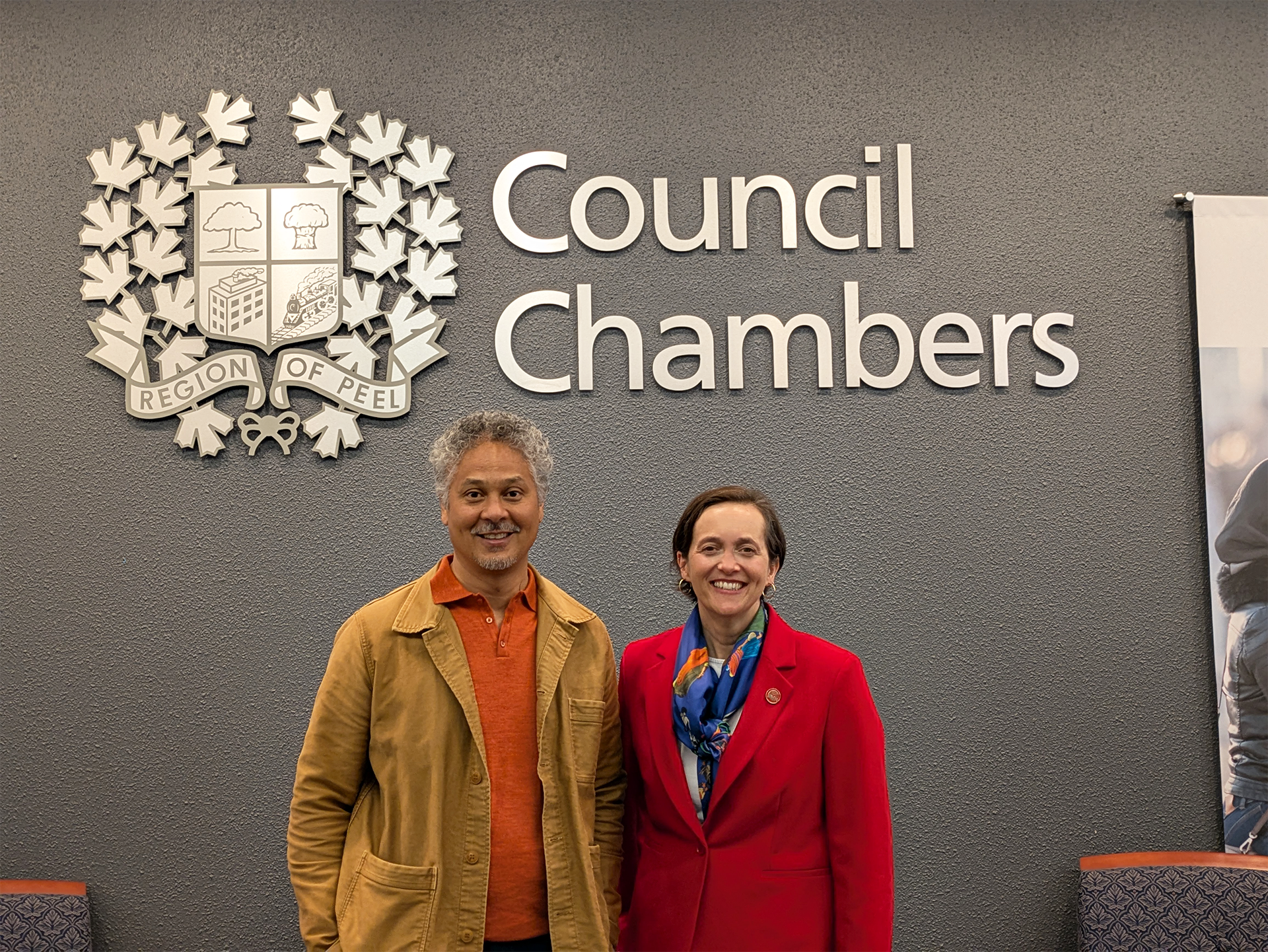
Late last month, United Way Greater Toronto’s President & CEO Heather McDonald appeared before the Council of the Regional Municipality of Peel with a blunt assessment. People across the region are facing rising costs, a shortage of affordable housing, financial instability and growing mental health needs that meet ever longer waitlists, she told councillors, and those pressures fall hardest on equity-deserving communities. The safety net meant to catch them, she added, is being asked to deliver more with less.
Her answer was collaboration.
“Solutions will not be found in isolation or in silos…. We respond by working together.”
Indeed, collaboration is embedded in United Way’s DNA, and ever-present in the statement next to the familiar hand logo: Working with communities in Peel, Toronto and York Region.
But what does working with communities mean exactly? Heather outlined the organization’s approach in her deputation:
United Way works with local residents on initiatives like the 7 agency and resident-led Community Action Grants in Cooksville. Focused on advancing key neighbourhood priorities — supporting employment, health and wellbeing, vibrant spaces and housing stability — the projects are innovative, tackling issues with art, digital toolkits and intergenerational gatherings.
United Way works with agencies. In Peel, United Way funds more than 60 agencies offering 100 programs, a wide variety of services from access to food, shelter and mental health to employment and settlement supports. Additionally, United Way continues to strengthen the ability of those agencies to remain in the communities they serve through capital grants to expand and modernize the vital spaces of neighbourhood anchors like the Muneeba Centre and Knights Table.
United Way works with corporate leaders and civic partners, to build cross-sector solutions to the toughest issues. We collaborate, for instance, with the Peel Labour Council on the Peel Community Benefits Network to ensure that large public infrastructure projects yield local benefits, from employment to goods and services procurement.
And United Way works with government. At all levels. Federal. Provincial. Municipal — 13 municipalities in total. And Regional. Indeed, partnership with government is crucial to United Way’s mission to improve social conditions and the goal of achieving long-lasting systemic change.
At the Regional Council meeting, the strong and enduring partnership between United Way and the Region of Peel wasn’t just a talking point in Heather’s remarks. It was in action, front and centre on the agenda in a presentation from the Peel Poverty Reduction Committee. Co-chaired by the Region and United Way, the Committee was there to share perspectives from their youth members and Lived Experience Roundtable as well as their newest report on efforts to mitigate the impacts of poverty felt by 8.6% of residents.
That partnership and spirit of collaboration is found daily, at work in myriad ways. At the Peel Community Safety and Wellbeing Table and Peel Situation Table. With the Peel Funders Consortium. Through the Peel Newcomer Strategy Group. And in the generous donations of Peel Region staff, through their annual workplace campaign, which supports United Way in reaching local residents, 100,000 last year alone.
The next step is already on the table: discussions to bring Community Hubs, United Way’s integrated service model, into Peel, where residents could reach housing, employment and mental health support under one roof.
Creating a more liveable Peel for everyone in Brampton, Caledon and Mississauga is not only a common goal, but also what residents expect of the Region of Peel and United Way Greater Toronto. Working together — aligning planning, pooling resources and acting in tandem — has never been more important. Working together is what will deliver that shared vision.