
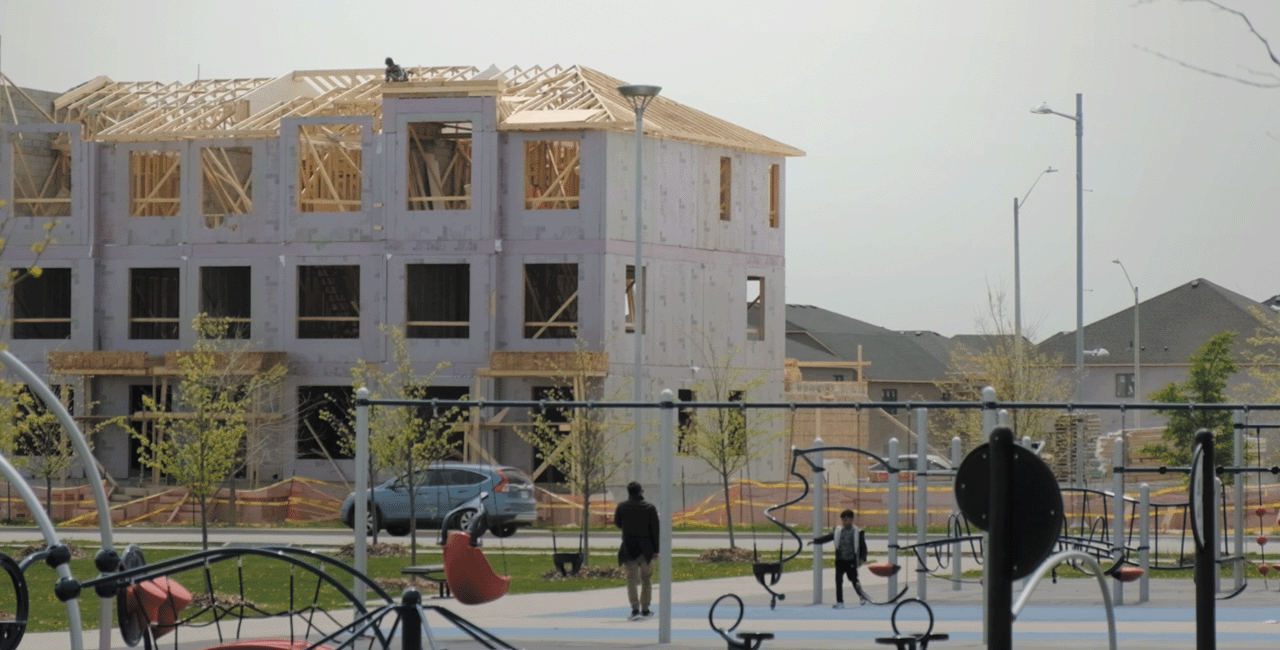
With the city’s population growth greatly outpacing market builds, on top of a shortage of affordable homes, Torontonians’ outlook on the housing crisis is bleak. But there is a way to remedy the state the city is in.
It is through investment in non-market housing — a.k.a. non-profit and community housing — which remains affordable in perpetuity, said Lori Galway, director of public affairs at United Way Greater Toronto (UWGT).
“There’s a disconnect between the level of homelessness and the affordable housing we need, and we are losing more affordable housing than we are building,” said Galway.
According to the Association of Municipalities of Ontario, there were 80,000 people who were experiencing homelessness in Ontario last year. Galway said investment in housing so far has been focused on creating more supply, but not the right kind of supply to assist those who require it.
The key to creating that supply, one that would provide stability and help more people in Ontario have a safe home, is detailed in Built for Good: Delivering the Housing Ontario Needs, a costed-out, actionable report developed by UWGT in conjunction with Co-operative Housing Federation of Canada and SHS Consulting
It outlines how Ontario can get closer to its goal of an additional 1.5 million homes in 10 years by redirecting its focus on non-market housing and scale that sector. Built for Good also details that, in order to reach a stable and sustainable state of housing, the system must define the roles of the different levels of government and ministries so that every player in the system can work together to reach the provincial housing target.
The report’s findings also make it clear that the market won’t do this on its own. “Everyone is finally realizing that,” said John Taylor, mayor of the Town of Newmarket.
A longtime housing advocate, he recalls being on the York Region Council 20 years ago when the wait list for non-market housing was under 5,000 applicants. It’s now ballooned to 18,000. To put that into perspective, Housing York builds 100 units every year, so wait lists just keep getting longer, he said.
“There’s a surge of people experiencing homelessness in the GTA, and in every community, and now is not the time for a lighthearted approval or a status quo approach,” Taylor said.
And while York Region is prepared to put more funding into housing, they can’t do it alone. Taylor said all levels of government must invest significantly into a minimum 10-year pipeline so that hundreds of units are built each year and so that housing wait lists shrink year over year, he said.
“The more complicated answer, though, is that if governments can’t or won’t step up to build large numbers of units every year, then we need a program that runs parallel [to it] that engages not-for-profit, for-profit and the government sectors,” Taylor said.
It’s a model Taylor said he is having conversations about on a smaller scale. For example, plots of land could be made available at no cost and no fees to a not-for-profit organization, which could then use investment by one or more levels of government to fund builds, with a not-for-profit running the program alongside a for-profit builder, he said.
He said the integrated model — with funding mechanisms in place for 10 years — should be put into action. “Because with one here and one there, we’re just not getting there quick enough. We need models that can scale.”
Sean Baird, president and CEO of Toronto Community Housing, agrees, noting that it’s harder than ever for young families to acquire a new home.
“Typically, the lowest 20 per cent of income earners in the city qualify for subsidized housing of some format, but the reality now is that people earning up to 40 or even 50 per cent of income percentile theoretically qualify,” Baird said.
Even more sobering, he added, is that the old trope that people will get back on their feet and exit social housing no longer holds true as there are no economical exits.
When it comes to building new housing, Baird said we need a number of components including access to land and a willing municipal partner. The third component, financing, is actually in good shape thanks to low-interest financing from the government and other financing organizations, he said.
Baird says where there is a challenge is in the ability for organizations like Toronto Community Housing to bring equity to the table. “We need about 25 per cent of our building costs up front.” This is where multiple levels of government can step up and provide access to significant equity so that these builds can get off the ground, he said.
To get that support, Baird said the key is continued advocacy to illustrate the extent of the need, where money is being spent and the costs.
To see firsthand how putting this approach into action can change a community, Baird recommends walking through neighbourhoods like Regent Park or Alexander Park. “The continued growth and investment into these neighbourhoods, where we are providing the supports necessary to help people thrive, that’s what I love to see — the difference of what this new approach to building brings to the community.”
Read more
December 02, 2025
Guiding United Way through the next decade
In this exclusive Q&A, Heather opens up about what drew her to the role of President and CEO and her vision for the next decade of impact across Peel, Toronto and York Region.
By directing federal funding locally and shaping policies rooted in community needs, United Way Centraide Canada helps all 57 United Ways, including ours, do more for a strong community services sector and a better GTA.
November 28, 2025
Building housing for the people who need it most
Our region’s housing outlook is bleak. With insights from United Way’s Built for Good report, this article breaks down how non-market housing works and what it will take to build the affordable homes people actually need.